Sent by Sergeant Henry Pratt
B Company 21st Regiment Royal Scots Fusiliers
British Expeditionary Force, France
26 December 1914
Dear Miss Waller,
It is with great pleasure that I write these few lines to thank you for your kindness in sending me the parcel which I received on Christmas Day.
As luck would have it we have just come out of our trenches and were billeted in a big house. It is a proper white Christmas here, snow and frost.
I would like to mention this about the Germans. They called a mutual armistice between us and them and never fired a shot from 11am to 11pm. Then our people went out and buried our dead which could not be buried before and the Germans helped us, so we must not paint all of them black.
I don't think the war will last long now. Then I hope to see you all again if God spares me.
Hoping this will find you enjoying good health.
Closing, wishing you all a Happy New Year.
I remain yours sincerely,
H Pratt coy CSM (Company Colour Sergeant Major)
Henry Charles Pratt was the son of William and Jane Pratt of
2 Nelson Cottages, Castle Street, Portchester
He was killed in action on 27th February 1915, aged 23 and is buried at Rue-David Military Cemetery, Fleurbaix, Pas De Calais, France
Miss Waller lived in Portchester House, Hospital Lane, Portchester and was instrumental in providing parcels to send to our troops during the Great War.
Three months previous to Henry's death, 26 November 1914, William and Jane were informed of the death of another son.
Leading Seaman William Pratt, Royal Navy, aged 27, who was killed in the explosion that destroyed the 15,000 ton battleship HMS Bulwark.
A large internal explosion resulted in the loss of 741 men whilst the ship was at anchor off Sheerness, Kent. Only a dozen men survived.
It was probably caused by the overheating of cordite charges that had been placed adjacent to a boiler room bulkhead.
His name is recorded on Portsmouth Royal Naval Memorial.
Information supplied with the compliments of Mrs Pam Foster, niece
We are delighted to send our congratulations to our Society member Richard Andrews, on being awarded the British Empire Medal in the Queen's New Year Honours.
Richard received the award for his contribution to the community of Portchester.
Richard has been a member of the Portchester Civic Society for 20 years, for many years serving on the committee. We are so proud to have his work appreciated with this honour.
A Portchester Hero of Trafalgar
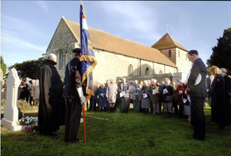
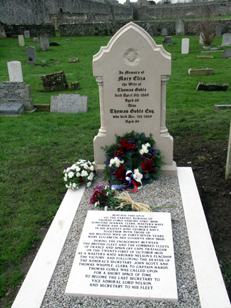 Most visitors to St. Mary's Church in the grounds of Portchester Castle used to walk past a fallen headstone near the entrance to the church without a second glance; little knowing that buried there is a man who fought alongside Nelson at the Battle of Trafalgar!
Sadly, Thomas Goble's tomb collapsed and was filled with earth to make it safe. In 2004 the headstone, which was almost unreadable, was lying flat upon the grave. Early in 2005, Richard Andrew's, a churchwarden and member of the Portchester Civic Society, mentioned at a Society meeting that St.Mary's church was having problems funding the restoration of the grave. As this was the 200th anniversary of the Battle of Trafalgar the Society decided to take on the restoration as a project and raise the money to restore the grave.
Thomas Goble was only 25 when he joined HMS Victory off Cadiz, just two weeks before the Battle. He served as a Master's Mate and carried the slate, recording the signals sent from the flagship during the battle. Sadly, John Scott, Nelson's Secretary, was killed at the beginning of the battle and young Thomas Goble was quickly promoted to Secretary to the Fleet. Shortly after, Nelson himself was struck down by a musket ball and died about three hours later. In Benjamin West's celebrated painting of the death of Nelson, Goble is portrayed looking down at the dying Nelson.
Surviving the battle, Goble was made a clerk and was Secretary to Captain Hardy. The following year he was appointed as a Purser. After Trafalgar he was awarded Prize Money of £44 4s 6d and a Parliamentary Award of £108 12s 0d, quite a sum in those days! He was discharged from the Victory in 1806, but continued to serve in the Royal Navy until 1825. In the late 1840's the Naval General Service Medal was issued and Thomas Goble was awarded this medal with the Trafalgar Bar. Thomas Goble is alleged to have had quite a fiery disposition and was twice court martialled during his naval career, the second time resulted in him being thrown out of the Navy.
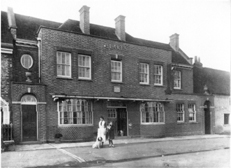 A book published round about 1925 and titled 'Portchester Castle' by Cooke, referred to the Pubs in Castle End that have since reverted to private dwelling houses, there only being one still left, The Cormorant. Of this Inn, it was stated that it had a career but no chronicler; and that it was a place where cock and rat fighting took place in the bars and that the house was a keen supporter of the famous Wicor smuggling gang. Hoping that the brewers would have a drawing, or better still, a painting of the old place, I wrote to Brickwoods and asked for their help. There came back a letter which made me wonder, stating - We have no pictures of the early Cormorant and only a drawing of the altered premises dated 1928. The name Cormorant was applied in 1824 or 1815. Our deeds show the premises as a public house in 1814 and as a public house bearing the sign of the Cormorant in 1815. It does not appear to have been a public house before 1814 since a conveyance of 1812 refers to it as a messuage, tenement garden only.' Cooke states in his book that the place was at one time known as the Swan, where did he get his story, that I would like to know?
 Contributed by Sue Bell
Hampshire Archive Trust, funded by the Heritage Lottery Fund, have produced a publicly accessible, virtual photographic archive of 10,000 images of aspects of life in Hampshire over the last 100 years or so. Portchester Civic Society contributed over 200 images to the project from its extensive collection. Details can be found on the Hampshire Records Office website.
Contributed by Paul Woodman
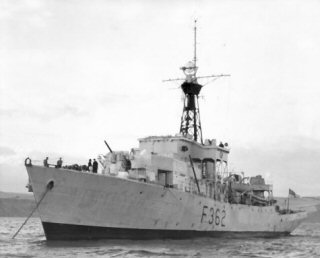
Allocated to the Western Approaches Command from Christmas Day 1943 until the end of the war, she served initially with Escort Group B1, then B7 from February 1944, B4 from late April 1944 and finally with the 30th Escort Group from 8th September 1944 until the end of the year, based throughout at Londonderry. Engaged in escorting Atlantic convoys until September 1944 she took no part in a successful anti-submarine action until the day after she joined the 30th Escort Group. On September 9th, 1944, HMS Portchester Castle, along with the frigate HMS Helmsdale, depth charged and sank U484 off the north west of Ireland. Some reports state that the U743 was destroyed in this action but the wreck of U743 was found in 2001 and is now thought to have been lost due to collision with an unknown vessel. The following month, on 11 November, she is also credited with taking part in the sinking of U1200 off Cape Clear, south of Ireland.
HMS Portchester Castle underwent a lengthy refit from 1st January until 1st May 1945 but saw no further action. In mid-June she was allocated to the West African Command as an Air Sea Rescue vessel and served from early July until 1st October 1945, when she left for Gibraltar to take up similar duties, leaving Gibraltar in the New Year 1946. She proceeded to Harwich where she was laid up in reserve.
In 1945 the Portchester Castle was in Freetown, Sierra Leone when she was called upon to assist in the sinking of the liner Edinburgh Castle, built in 1910, which had been used in the port as an accommodation ship for naval personnel and survivors of sunken vessels. As towing back to England would not be cost effective, the Edinburgh Castle was towed 60 miles out to sea and sunk by gunfire and depth charges from the armed trawler Cape Warwick and the corvettes Portchester Castle and Lancaster Castle.
In April 1951 she was prepared for service and after commisioning on 15th May was allocated to the 2nd Training Squadron, based at Portland, for anti-submarine warfare and general seamanship training. It was whilst at Portland that the ship was chosen to portray the fictional frigate HMS Saltash Castle in the film "The Cruel Sea". The pennant number, changed to F362 in 1948, was still retained during the film. The film starred Jack Hawkins, Donald Sinden, Denholm Elliot and Virginia McKenna in a documentary style account of life on board a British warship during the Battle of the Atlantic in World War II. I recently corresponded with a lady whose father joined the Royal Navy in 1951 as a National Serviceman and served on the Portchester Castle during the filming. The filming was done at Portland and in the Channel and at one time several members of the ship's company were sent over the side, covered in grease, to play shipwrecked survivors. He doesn't believe they received any royalties! HMS Portchester Castle continued serving with the 2nd Training Squadron until June 1956 when she was relieved by the Type 14 frigate HMS Keppel.
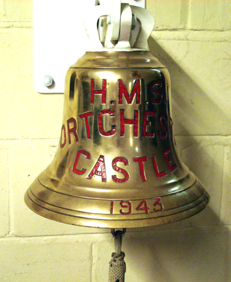
In 1956 the ship was laid up in reserve at Devonport. She was destined for scrap in 1958 but on the 15th May, while in tow of the tug Brigadier, she broke adrift but was later brought into Milford Haven. On the 17th May 1958 she arrived at Troon for scrapping. The ship's bell today hangs in Cobham Hall, the Scout Hut in White Hart Lane.
We hope this will be the first of many thumb - nail sketches of Portchester's past, a past that goes back to early Stone Age times. Evidence of human occupation has been found at Red Barn on the slopes of the old chalk cliffs which once marked the sea boundary of the north of Portsmouth harbour.
The village grew up in historic times round a spur of land where the Romans built a fort to defend the local area from maritime invaders in the third century A.D. The fort encompassed some nine acres ( nearly four hectares ) with a wall and towers that still exist. Inside are a medieval church, St. Mary's, and a moated castle. The church is the local parish church and English Heritage are responsible for the castle. Both have had a fascinating history and welcome visitors.
By 1914 there were about 1,000 people living in Portchester. Since then the population has grown to some 20,000 in the 2001 census, mostly working in Portsmouth, 7 miles ( 12 km. ) to the east, in Fareham, the town of our urban district council, or in Southampton, 10 miles ( 17 km. ) to the west.
Contributed by
Bryan Jerrard
Portchester's history is dominated by the castle, which is essentially and originally a Roman fortress. The walls, some 180 metres long from north to south and slightly more from east to west, are among the best preserved in northern Europe and are some 5.5 metres high to the wall-walk. Built of coursed rubble and mainly flint with elements of red tile and stone, they were once some 3 metres thick at ground level.
To the right of the Land Gate in the west wall one may see in a long stretch how different gangs of builders were allocated their different sections of work. The gateways were built in the centre of each wall, the main gates being to the east and west and lesser gates, posterns, to the north and south. Twenty round bastions at regular intervals were built and some 15 have survived until today. A Norman castle was constructed in the western corner.
The original Roman fortress was built at the end of the 200s AD and was part of a chain of coastal defences from The Wash, round Kent and Sussex to Southampton and to Cardiff. Most were placed under the command of an officer called the Count of the Saxon Shore whose job was to protect ships in harbour on both sides of the English Channel and the empire from incursions by Saxon invaders.
Those defending the fortress were not high status Roman soldiers and archaeological evidence points to their withdrawal by about 369, a generation before the general withdrawal of Romans from Britain in about 410 AD.
Contributed by Bryan Jerrard
Contributed by Bryan Jerrard
Contributed by Bryan Jerrard
Contributed by Arthur Watson
Contributed by Reginald Ash
Extract from "The European Magazine and London Review" Jan. 1801
Transport Office, 11th.Sept. 1800
Sir,
We include, for your information, a copy of a letter which we have this day received from Mr. Holmwood, the agent for prisoners of war at Portchester and also a copy of the one therein referred to from several French prisoners confined at that place, stating that they are in a very miserable condition from the want of clothing. We cannot pass this opportunity without again recommending to your most serious attention the absolute necessity that there is of causing some clothing to be distributed among the French prisoners without delay.
Rupert George
Ambrose Serle
Joseph Hunt
M. Otto (No. 19)
Portchester Castle
10th Sept. 1800
Gentlemen,
I beg leave to enclose you a letter I have this day received from the prisoners at this depot, stating the deplorable state they are in from want of clothing;
I have the honour to be
(Signed) John Holmwood
Commissioners for the Transport Service etc. (Translation)
Portchester
10th Sept. 1800
Sir,
You have so often and so generously given us proofs of your feelings for our unfortunate situation, that we believe we may implore, through you, a relief the most most urgent; as it becomes indispensable. It cannot be necessary to lay before you a minute picture of the state of nakedness to which we are reduced; a state the more deplorable, as our debilitated bodies are the more susceptible of the severity of the season, and the want of repose. The many sufferings we endure from the total want of clothing and other necessaries of this kind, are already so well known to you, that there can be no difficulty in your interceding in our favour. We cannot doubt of your complying with our expectations in this respect, or at least, that you contribute every means in your power to alleviate the misfortunes of persons sinking under the weight of calamity; and. you will be these means, add to the respectful sentiments with which we are etc. signed by a considerable number of prisoners
Material provided by Mr. A. P. SHEER of Portchester
Contributed by Sue Bell
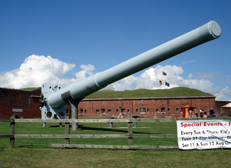
Standing proudly outside Fort Nelson and trained as if to fire across Portchester is a battleship's 14-inch gun barrel.
Portchester Civic Society member Reginald Ash, himself an ex Royal Navy Weapon Engineer, has researched the history of the barrel with the assistance of Philip McGrath, Curator of Artillery at the Royal Armouries, Fort Nelson.
The gun at Fort Nelson was number 136, which is the last one manufactured by Vickers Armstrong in 1946. It went to Woolwich in 1947 for proof firing and was certainly still there in 1949. Shortly thereafter, probably between 1956 and 1958 it went to the Royal Ordnance Factory, Kings Road
Mr Ash has also provided the following article regarding 14-inch guns in use.
In 1941 during World War II, the battleship HMS King George V, armed with ten 14-inch guns, was involved in the conflict with the Bismarck, pride of the German Fleet, as HMS Hood had already been sunk and Churchill was keen to mobilise all available resources to exact vengeance.
K.G.V. was ready with her armament available after preliminary firing practice of her main guns had taken place. The P.F.P.s, as they were known, involved the fitting of a smaller gun in the barrel of the main gun and firing six pounder rounds, to prove accuracy of the main armament. The fitting of the sub calibre gun, as it was known, was a very exacting and skilled process as failure to ensure concentricity of the new item could result in damage to the parent gun from eccentric rounds.
The damage to the rifling of the parent gun became apparent on removal of the six pounder when attempts to pass the plug bore gauge through the main barrel were unsuccessful. Drastic measures were considered and the favourite was to haul a man through the barrel who was able to have sufficient skill and dexterity to use a hammer and cold chisel! The person in question had also to be slender and fit. An Ordnance Artificer, Wilfred Dunbavand, fitted the role and he entered the barrel at the breech end where damage had to be minimal. He laid on a lightweight metal tray with the plug bore gauge attached to the rear of the tray, while the front of the tray was to be pulled by a rope fed from the muzzle end. After extremely arduous physical effort and ingenuity he emerged from the muzzle, covered in scratches to his entire body, as the contour of the rifling was razor sharp.
Some ten years later, in 1951, I was to serve with Wilfred in the destroyer HMS Zodiac, when he, reluctantly, divulged a brief reason for his wearing the Oak Leaf decoration. I was unable to find a citation of the award in the 1941 London Gazettes but I have been assured that, in wartime, events in the field of conflict could merit Commander in Chief's having total authority for such action as awarding the Mention in Dispatches citation "in the field". Needless to say, the gun in question played its part in the sinking of the Bismarck.
We have recently received an email from Lorayne Emery with more details of this event; Lorayne wrote "Wilfred DunBavand was my father and the record of his being mentioned in Despatches in the London Gazette appeared in the Supplement to the London Gazette dated 8th June 1944, page 2609, halfway down on the left hand column. The supplement was numbered 36544. I actually have this copy. I must also mention that OA Third Class, Arthur Rothwell P/MX62798 was also involved in freeing the shell. They were the only two people in the crew that were small enough to be pushed inside. They could only stay inside for about 15 minutes at a time due to the freezing weather conditions. They were covered in grease in order to project them up inside the gun. We only found out the actual details when Dad died and his life long pal told us. It was something Dad didn't talk about although he regaled us with all his time in post war service. He never talked about the war except to say he spent his 21st birthday chasing the Bismark."
Remember the old Royal Hospital in Portsmouth, now the site of a Sainsbury's supermarket near the ferry port.
Built to serve the city and surrounds including Portchester, creation of the Portsmouth, Portsea and Gosport Hospital had depended on locals raising building and running costs. Land was leased for a peppercorn rent from the government's Ordnance Board.
When Queen Victoria's husband Prince Albert laid the foundation stone on September 27, 1847, Portchester folk could take pride in having helped the appeal. A record of monies raised between opening year 1849 and July 1897, pinpoints several modest subscriptions to the £12,697 total.
A Mr John Read of Portchester gave ten guineas (£10.50), an impressive amount when well-known Portsmouth families like Brickwood had donated twenty-five guineas. There were three guineas from a Mr H Calloway and one guinea from Mr Heard, of "The Jungle", now the home of the Portchester Sailing Club.
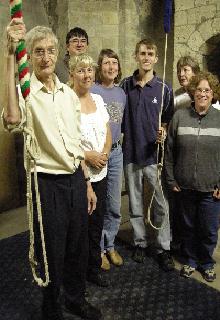
Robert English will not hum that old Bing Crosby favourite if you ask does he know the bells of St Mary's. The enthusiast who renewed traditional bell ringing at Portchester's Anglican church knows its bells up close and personally.
As Bell Tower Captain he trains a team of enthusiasts in the techniques and mystique of campanology and would welcome more ringers. "Bell ringing goes back hundreds of years. When we ring at St Mary's it really is all due to Queen Elizabeth 1. When she visited her castle at Portchester and saw the church had no bells she said she wanted some here. Her order was obeyed.
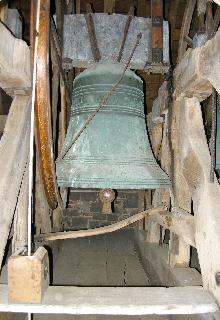
The tower carries a ring of three bells. The earliest dated 1582 weighs 7.5 cwt and carries the inscription "Obey God and the Prince. Next up and weighing almost 8 cwt was cast in 1632 by a travelling bell founder John Higman. The following year a Chichester man William Wakefield made the treble third bell. There are no records of how the bells reached Portchester and were hoisted into position.
Amazingly they hang on the original wood frame. When an expert from Whitechapel Bell Foundry inspected the bells in the 1880s he recommended a modest strengthening of the frame and a rehanging in new fittings.
Civic Society member and church guide Bryan Jerrard has a copy of the churchwardens records showing the work cost £50 and 5pence, plus a further £11 10 shillings in 1914. "Interestingly I've come across the church bill for new bell ropes in 1772. It was £13 4 shillings compared to £300 this year.
Mr English said, "Bell ringing as we know it is a purely English exercise. As our empire expanded settlers took the tradition to Australia, New Zealand, Canada and parts of The United States.
I have been ringing since I was 15. Bells summon you to church and are rung for weddings, funerals and some special occasions. They were silenced during World War 2 to be rung only if we were invaded. They sounded round the land when victory was declared.
When I came to Portchester regular bell ringing had become sporadic. Now I have a good team to call on but could do with some more. It's difficult to hear the bells from beyond the castle walls so when we stop ringing five minutes before the service, some people have to gallop to get here.
To ring every tuneful permutation depends on the number of bells in a tower. For instance, if a tower has twelve bells as at St Thomas' Cathedral in Portsmouth, it would take 37 years to ring all the changes. There is a church in Birmingham with 16 bells. It has been calculated that the task would take 2 million years.
Bell ringing is a fascinating pastime and I'd be happy to hear from anyone wanting to know more about the bells, the tower and the skills. Mr English also teaches a mini version of campanology to his team of hand bell ringers who also would welcome some newcomers.
He can be contacted on 023 92 326560.
Maggie Beddoes
On a sunny day in June 1933 the music of old England rose above the walls of Portchester Castle. Thanks to Portsmouth Centre of the Old English Folk Dancing and Song Society enthusiasts from a 20-mile radius flocked to the elaborate party. The event was part of the celebration of the 800th anniversary of St Mary's parish church within the walls. The Hants Chronicle reported that spectators from France and even from India mingled with crowds of 700 enjoying dance and songs from centuries ago.
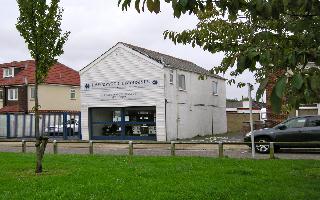
Some three story houses now occupy the former farm stables and the more recent Lawnswood site
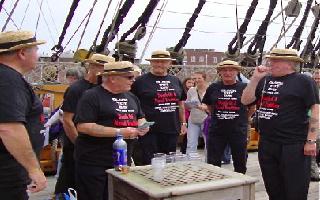 Piping "Tot's up" on HMS Victory's quarterdeck